A plain poured concrete patio costs less to put in than a paver patio. HomeGuide’s pavers-vs-concrete guide (May 2025) puts a basic concrete patio at $5 to $15 per square foot installed, or $2,000 to $6,000 for 20×20, and an average paver patio at $10 to $17 per square foot, or $4,000 to $6,800. Pavers win back some ground later: HomeGuide says a cracked paver can be swapped out on its own. Once concrete is stamped or colored, the two prices get close, and the guides disagree on which is lower.
Cost side by side
Each guide measures its own way, so the numbers sit in separate columns rather than being averaged. All are installed prices per square foot.
| Patio surface | HomeGuide pavers vs. concrete (May 2025) | HomeGuide patio guide (Jul 2025) | Concrete Network (Jan 2026) | Fixr (Aug 2022) | This Old House (Jun 2026) |
|---|---|---|---|---|---|
| Plain poured concrete | $5 – $15 | $4 – $12 | $5 – $8 | $6 – $17 | $2 – $15 |
| Pavers | $10 – $17 (high-end $25 – $40) | $10 – $30 | $4 – $20* | $10 – $25 | $8 – $25 |
| Stamped concrete | $8 – $19 | $9 – $30 | — | $15 – $30 | $5 – $15 |
*From Concrete Network’s patio cost page. Its stamped cost page (reviewed Jan 2026) gives a different paver figure: “Their beautiful look will most likely cost about $10-23 per square foot depending on your overall design.”
For a 20×20 patio, HomeGuide’s pavers-vs-concrete guide gives:
| 20×20 patio (400 sq ft) | Total installed |
|---|---|
| Basic concrete | $2,000 – $6,000 |
| Exposed aggregate concrete | $2,800 – $7,200 |
| Stamped concrete | $3,200 – $7,600 |
| Average pavers | $4,000 – $6,800 |
| High-end pavers | $10,000 – $16,000 |
If an old concrete patio has to come out first, the tear-out itself is a separate line either way; preparing the base for the new surface is priced on top of it. HomeGuide’s removal guide puts tearing out a 20×20 concrete patio at $1,200 to $3,000; see cost to replace a concrete patio.
Where the money goes
The gap is mostly labor. HomeGuide’s footnote: “Installation adds $3 to $5 per square foot for concrete and $7 to $13 per square foot for pavers.” Material prices overlap: $3 to $7 per square foot for a concrete slab and $1.25 to $18 for concrete pavers, and HomeGuide says paver installation “also requires a base, which adds $1.40 to $2.20 per square foot.”
This Old House puts it plainly: “Concrete pavers usually cost more than concrete slabs because creating pavers requires additional labor.” Fixr’s 2022 labor table is the exception, listing $5 to $10 per square foot for both poured concrete and pavers.
How each one is built
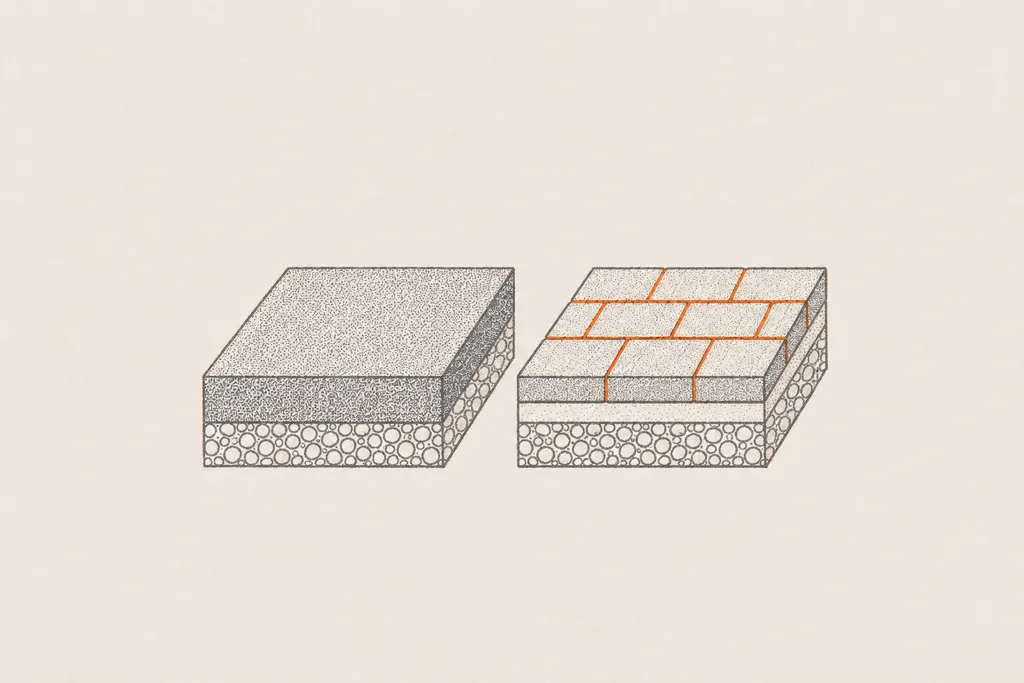
Poured slab. HomeGuide notes (about extending a patio) that the area “still needs grading, along with a sand or gravel base below the concrete,” and says “Standard residential patios are 4 inches thick.” Rebar or wire mesh adds $1 to $3 per square foot. The concrete is poured as one piece and “takes several days to cure before it’s ready for use.” A 20×20 patio at 4 inches needs about 4.94 cubic yards of concrete.
Pavers. Fixr: “Pavers are set in a bed of sand or gravel. Sand is pushed between the joints to fill them.” HomeGuide says installers “place each paver stone individually” and then “fill the gaps and joints with polymeric sand.”
Both need the ground dug out, so whoever does the work should call 811 first; the national 811 service says “you must contact 811 a few days in advance to stay safe.”
Stamped concrete vs. pavers
This is where the guides split:
- Concrete Network: “Stamped concrete is less expensive, as pavers are placed individually and require more labor.”
- Bob Vila (2024): “stamped concrete costs are typically higher, but a simple paver design can cost less than a complex stamped concrete pattern.” Its table prices 200 square feet of stamped concrete at $2,400 to $3,600 and pavers at $2,200 to $3,000.
- HomeGuide’s averages put stamped concrete ($8 to $19) just under average pavers ($10 to $17) at the low end and above them at the high end.
Concrete Network sums it up: plain concrete will “save you money when compared to pavers,” but “as you add upgrades, like stamping and coloring, the prices become more comparable.” Detailed stamped prices are in stamped concrete cost.
How each holds up over time
| Pavers | Poured concrete | |
|---|---|---|
| Lifespan (HomeGuide) | 25 – 75+ years | 30 – 50+ years |
| Cracking (HomeGuide) | “typically don’t crack from freeze-thaw cycles”; “may loosen over time” | “more susceptible to cracking over time from extreme temperatures or ground shifting” |
| Weeds (This Old House) | “prone to weed growth between joints” | — |
| Walking surface (HomeGuide) | “better traction but may create a bumpier walking surface” | “smoother surface to walk on but may become slippery when wet” |
HomeGuide also says pavers have “an average strength four times higher than that of a concrete slab,” and that while pavers cost more up front, concrete may end up costing more over the long term because of upkeep.
Which fits your yard
The guides point in different directions depending on the site:
- Cold winters: Fixr says “Concrete does better in hot climates than climates with freeze/thaw cycles.” HomeGuide says pavers “hold up better in harsh weather.”
- Shifting soil: Fixr suggests poured concrete over pavers where the soil shifts: “If you have shifting soil in your yard, consider using poured concrete.” It also suggests speaking to an engineer if you’re concerned.
- Budget now vs. later: every guide above says plain concrete costs less up front; pavers trade a higher first cost for replacing single pavers.
Questions to ask before you sign
- What base goes under it, how deep, and is grading included?
- For concrete: what thickness, and rebar or wire mesh? Where do the control joints go?
- For pavers: what bedding layer and joint sand, and what holds the edges?
- Is removal of the old patio a separate line, and what does it cost?
- How does the patio slope away from the house?
- Who pulls the permit, if one is needed?
- What does the warranty cover: cracking, settling, loose pavers?
To price a poured patio at your size, with or without stamping, use the concrete cost calculator.
Have your own measurements? Run the concrete cost calculator — cubic yards, bags and a sourced price range for your size.
Illustrations here are AI-made sketches that show the idea. They are not photos of a real slab, driveway, product, job or person.
Sources
- HomeGuide — What is the Cost of Pavers vs. Concrete? (2026 Prices & Differences) (written by Tara Farmer, dated May 30, 2025)
- HomeGuide — How Much Does a Concrete Patio Cost? (2026) (written by Kristen Cramer, dated July 10, 2025)
- HomeGuide — How Much Does Concrete Removal Cost? (2026 Prices) (written by Sarah Noel, dated May 27, 2025)
- Fixr — Cost to Build a Patio (updated Aug 19, 2022)
- Concrete Network — Concrete Patio Cost (updated Jan 20, 2026)
- Concrete Network — Stamped Concrete Cost (reviewed Jan 26, 2026)
- Bob Vila — Here's How Much a Stamped Concrete Patio Costs (updated Apr 26, 2024)
- This Old House — Concrete Patio: A Comprehensive Guide (updated June 8, 2026; cost data from Angi and HomeAdvisor)
- Common Ground Alliance — 811 Before You Dig (no update date shown; checked Nov 2, 2026)
Updated November 2, 2026
Before you build
Call 811 a few business days before any digging so buried utility lines get marked. Driveway aprons, foundations and taller retaining walls may need a permit — ask your local building department. Wet concrete can burn skin: crews wear gloves, boots and eye protection. Get the price, thickness, base and reinforcement in a written contract with a contractor who carries the license (where your state requires one) and insurance.