A new concrete driveway costs $6 to $15 per square foot installed, or $2,400 to $8,600 for a two-car driveway, according to HomeGuide (June 2025), for plain gray to basic decorative concrete. HomeAdvisor (June 2026) is higher: $8 to $20 per square foot, an average of $6,400, and most projects between $2,700 and $14,500. Fixr (January 2025) puts the national average at $3,460 to $6,910, with most homeowners paying around $5,184 for a 24-by-24-foot broom-finish driveway 5 inches thick (Fixr’s page writes “5’,” which reads as feet). These are prices for a new pour (Fixr’s itemized lines are below); tearing out an old driveway is extra (see concrete driveway replacement cost).
Cost by driveway size
| Size | Square feet | HomeGuide (standard to basic) | HomeAdvisor | Fixr |
|---|---|---|---|---|
| 1-car, 10 x 20 ft | 200 | $1,200–$3,000 | $1,600–$3,000 | $800–$4,000 |
| 1-car, 12 x 24 ft | 288 | $1,700–$4,300 | $2,300–$4,300 | $1,152–$5,760 |
| 2-car, 20 x 20 ft | 400 | $2,400–$6,000 | $3,200–$6,000 | $1,600–$8,000 |
| 2-car, 24 x 24 ft | 576 | $3,500–$8,600 | $4,600–$8,600 | $2,304–$11,520 |
| 3-car, 24 x 36 ft | 864 | $5,200–$13,000 | $6,900–$13,000 | $3,456–$17,280 |
Fixr’s ranges are widest because they span its full $4 to $20 per square foot, “from $4 for paving over gravel to $20 a square foot for complex patterns.” HomeGuide notes that larger driveways “often have a lower price per square foot due to economies of scale.” For reference, Concrete Network says the average two-car driveway in the U.S. is 16 by 40 feet, or 640 square feet.
Cost per square foot by finish
| Finish | HomeGuide (Jun 2025) | Fixr (Jan 2025) and HomeAdvisor (Jun 2026) | Concrete Network (Jan 2026) |
|---|---|---|---|
| Plain gray | $6–$10 (“standard”) | $6–$8 | $5–$8 |
| Broom finish | standard ($6–$10) driveways “typically feature a simple broom finish”; the basic tier ($10–$15) also lists “broom-finish texture” | $8–$12 | plain ($5–$8) “may have a basic broom or rock salt finish”; basic ($8–$14) also lists a textured “(broom finish, etc.)” finish |
| Exposed aggregate, single color | $10–$15 (“basic”) | $8–$12 | $8–$14 (“basic”) |
| Stamped | $8–$26 (“Prices at the high end of the range also include colored concrete”) | $12–$18 | $14–$21 (“mid-range,” two or more colors or patterns) |
| Stained | $8–$25 | $18–$20 | — |
The guides don’t agree on whether a broom finish is “plain” or an upgrade, so ask what finish a quote includes. More on decorative work: stamped concrete cost.
What’s inside the price per square foot
HomeGuide splits a standard-to-basic driveway into labor at $3 to $7 per square foot and materials at $3 to $8. HomeAdvisor says to plan on labor “making up half of your bill.” Fixr itemizes the steps of a new pour:
| Line | Fixr (Jan 2025) |
|---|---|
| Excavation and grading for a new driveway | $50–$70 an hour |
| Sub-base of sand and gravel | $12–$18 a cubic yard |
| Setting forms, placing and raking concrete, stripping forms | $1.50–$2 per sq ft |
| Concrete delivered | around $110 a cubic yard, plus delivery fees of around $60 |
| Specialty finish labor | $3–$18 per sq ft |
Elsewhere on the same page, Fixr says most concrete is “sold and poured by the cubic yard, at $125 to $150 a yard,” so its two per-yard figures don’t match. Price per yard is covered in concrete cost per yard.
How much concrete. Volume is length × width × thickness in feet, divided by 27 for cubic yards. A 24-by-24-foot driveway takes about 7.1 cubic yards at 4 inches, 8.9 at 5 inches and 10.7 at 6 inches (our arithmetic). Concrete Network says to order 10% to 15% more than the computed volume.
What changes the price
- Thickness. HomeGuide: a standard 4-inch slab costs $6 to $15 per square foot, while 6 inches, “recommended for heavy vehicles,” costs $8 to $20. See how thick should a concrete driveway be.
- Reinforcement. HomeGuide prices rebar at $1 to $3 per square foot. HomeAdvisor gives $0.70 to $2.55 per linear foot of rebar, which isn’t the same unit.
- Grading. HomeGuide: $3 to $8 per square foot, or $700 to $2,500, and “many driveway contractors include grading in their driveway prices.”
- Shape and slope. HomeGuide says curved or circular designs cost more, and Fixr says driveways on steep hills “often have higher costs for labor.”
- Apron. The section that connects to the street: Fixr $1,536 to $4,320, HomeAdvisor $1,530 to $4,320.
- Sealing. HomeGuide $1 to $3 per square foot; Fixr $1 to $2.
- Permit. The guides disagree. HomeGuide says most residential driveways “require permits costing $50 to $200”; Fixr says “in most areas, a permit is not required to install a new driveway.” Ask your local building department, especially for work at the curb or sidewalk.
Joints and reinforcement
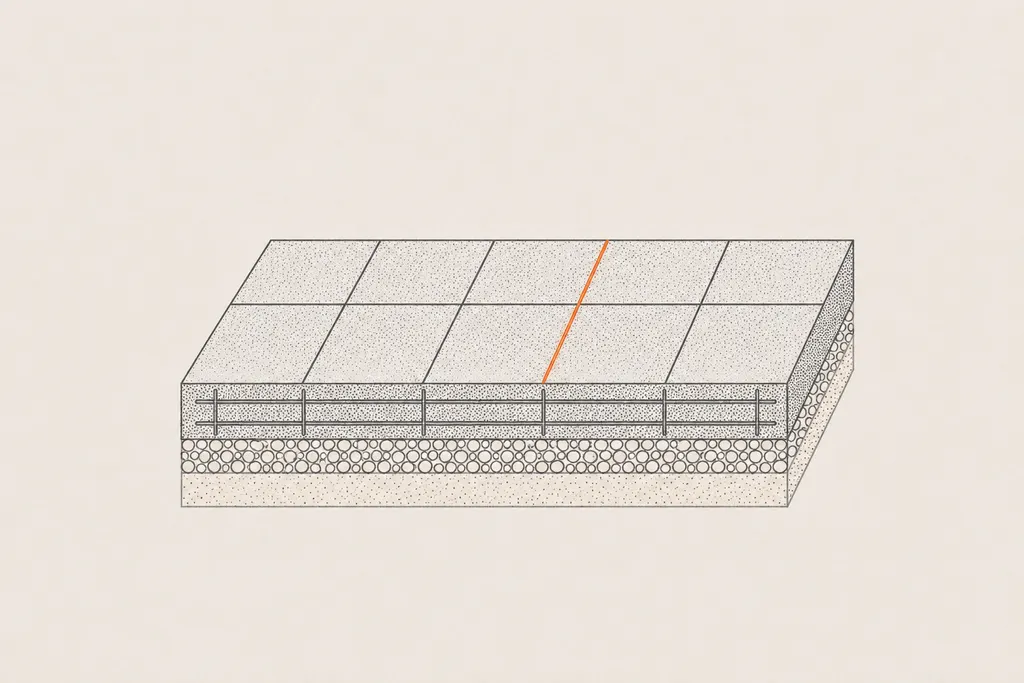
The National Ready Mixed Concrete Association’s sheet on joints (CIP 6) explains that concrete’s “overall tendency is to shrink and this can cause cracking at an early age,” and calls joints “simply pre-planned cracks.” It recommends:
- a maximum joint spacing of 24 to 36 times the slab thickness, about 10 feet for a 4-inch slab, and limited to 15 feet at most;
- panels “square or nearly so,” with the length no more than 1.5 times the width;
- contraction joint grooves at least one-fourth of the slab thickness deep, and not less than 1 inch;
- isolation joints “at junctions of driveways with walks, curbs or other obstructions.”
The Illinois Ready Mixed Concrete Association, a state industry group whose driveway guidelines cite Michigan specifications (MDOT aggregate, “Michigan is classified as a severe weathering region”), adds that “a centerline control joint is required for driveways greater than 12 feet in width.” Treat that as one regional guideline, not a national rule.
On steel, Concrete Network says wire mesh suits driveways 4 to 5 inches thick and ½-inch (#4) rebar those 5 inches or more, set in a grid about 12 inches apart on blocks so it stays centered in the slab. “Reinforcement won’t prevent cracks, but it will help hold them together if they do occur.” Synthetic fibers help reduce shrinkage cracks but “will not provide structural reinforcement.” NRMCA’s CIP 6 makes the same point about mesh: it “will not prevent cracking.”
Questions to ask before you sign
- What thickness, concrete strength (psi) and reinforcement are in the price?
- What’s the joint plan: spacing, depth, and isolation joints at the garage and sidewalk?
- How many inches of base go under the slab, and is grading included?
- Which finish is included, and what does each upgrade add per square foot?
- Is the apron included, and who handles any city permit?
- How long before I can drive on it? Concrete Network says to let it cure “for at least a week.”
Call 811 a few business days before any digging so buried lines get marked. To price your own size, thickness and finish, use the concrete cost calculator.
Have your own measurements? Run the concrete cost calculator — cubic yards, bags and a sourced price range for your size.
Illustrations here are AI-made sketches that show the idea. They are not photos of a real slab, driveway, product, job or person.
Sources
- HomeGuide — How Much Does a Concrete Driveway Cost? (June 3, 2025)
- HomeAdvisor — How Much Does a Concrete Driveway Cost in 2026? (updated Jun 20, 2026)
- Fixr — How much does it cost to pour a concrete driveway? (updated Jan 31, 2025)
- Concrete Network — What's the Average Cost of a Concrete Driveway? (updated Jan 13, 2026)
- Concrete Network — 8 Concrete Driveway Construction Essentials (updated Mar 12, 2026)
- Concrete Network — How Much Concrete Do You Need for a Driveway? (no update date shown; checked Nov 2, 2026)
- National Ready Mixed Concrete Association — CIP 6, Joints in Concrete Slabs on Grade (1979, 1989 and 1998; copy hosted by Prairie Material), p. 1–2
- Illinois Ready Mixed Concrete Association (state industry group; its driveway guidelines cite Michigan specifications) — Driveways, homeowner guidelines (used by permission of NRMCA; no update date shown; checked Nov 2, 2026)
- Call 811 (Common Ground Alliance) — 811 Before You Dig (checked Nov 2, 2026)
Updated November 2, 2026
Before you build
Call 811 a few business days before any digging so buried utility lines get marked. Driveway aprons, foundations and taller retaining walls may need a permit — ask your local building department. Wet concrete can burn skin: crews wear gloves, boots and eye protection. Get the price, thickness, base and reinforcement in a written contract with a contractor who carries the license (where your state requires one) and insurance.