A concrete driveway for everyday cars should be at least 4 inches thick. Concrete Network says “a minimum thickness of 4 inches is sufficient for a residential concrete driveway supporting a standard passenger vehicle or SUV weighing between 3,000 to 6,000 pounds,” and that truck traffic or a large RV may call for 5 or 6 inches. Many cities also set a thicker minimum, often 5 or 6 inches, for the apron and sidewalk crossing at the street. The residential concrete code from the American Concrete Institute, ACI 332-20, sets the floor at 3½ inches, according to the Tennessee Concrete Association’s summary, but every guide below recommends at least 4.
Thickness by use
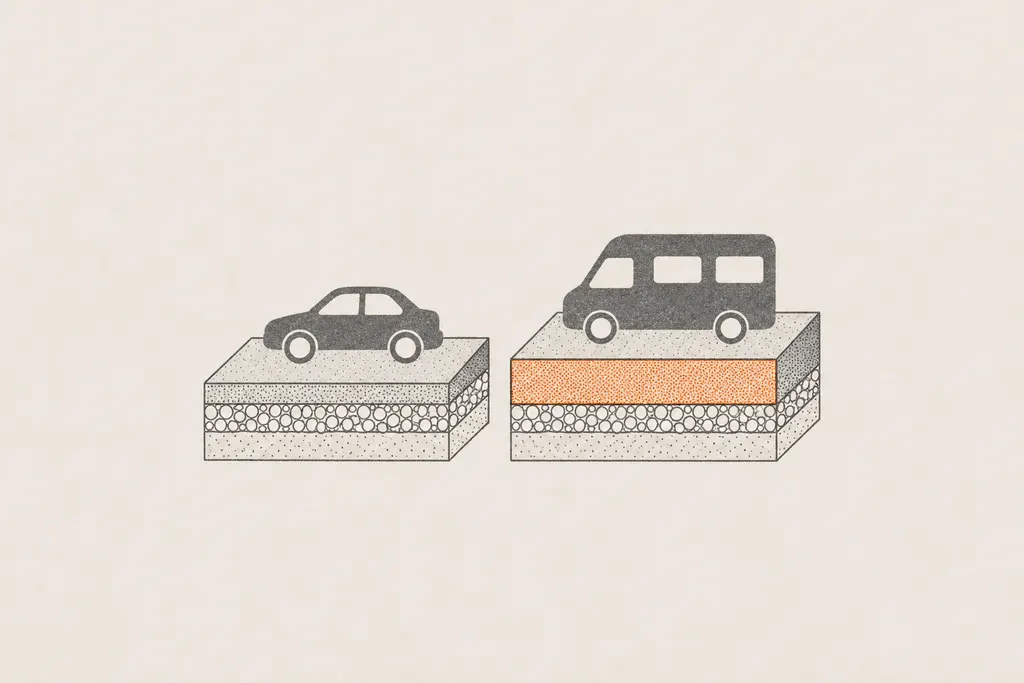
| What the driveway carries | Thickness | What the source says | Source |
|---|---|---|---|
| Cars and SUVs | 4 inches minimum | “a minimum thickness of 4 inches is sufficient for a residential concrete driveway supporting a standard passenger vehicle or SUV” | Concrete Network (2023) |
| 4 inches minimum | “Concrete driveways need to be at least 4” thick.” | Fixr (2025) | |
| A heavy truck parked on it | 5 inches minimum | “If you plan on parking a heavy truck, the driveway needs to be at least 5” thick.” | Fixr (2025) |
| RVs or regular commercial traffic | 5–6 inches | “For heavier vehicles like RVs or regular commercial traffic, pros recommend 5 to 6 inches.” | HomeGuide (2025) |
| Truck traffic or a large RV (12,000 pounds or more) | 5–6 inches | “you may need to increase the thickness to 5 or 6 inches to provide the necessary support” | Concrete Network (2023) |
| Heavy vehicles | 6–8 inches | “a six- or eight-inch thickness is desirable for those with heavy vehicles” | HomeAdvisor (2026) |
| Edges | 1–2 inches thicker | thicken the edges “by 1 or 2 inches,” extending “4 to 8 inches” in from the slab edge | Concrete Network (2026) |
| 6–8 inches | “The edges should be 6 to 8 inches to prevent cracking and breaking at vulnerable points.” | HomeGuide (2025) | |
| Apron at the street | often 5–6 inches | “Many municipalities will require the apron to be constructed at a 5- or 6-inch thickness” | Concrete Network (2023) |
Most of these are cost guides and an industry website, not codes. Treat them as starting points for the conversation with your contractor, who should know local soil and climate.
What the codes actually say
- ACI 332-20. The Tennessee Concrete Association’s summary of the code lists a “minimum concrete thickness of 3 ½”” for driveways, along with a properly prepared and compacted subgrade, joints “at proper depth and spacing,” and curing. ACI’s own preview says ACI 332-20 covers concrete “slabs-on-ground” for one- and two-family homes and superseded ACI 332-14 in 2020.
- The building code. The 2024 International Residential Code says concrete slab-on-ground floors are built to that section “or ACI 332” and “shall be not less than 3½ inches (89 mm) thick” (Section R506.1). That section is written for floors, and the Tennessee Concrete Association notes that local residential codes there “do not address the design and construction of concrete driveways.” Your state or city may have adopted a different edition.
- City rules. These are what you’ll most often run into. Shaker Heights, Ohio, requires a concrete driveway of at least 4 inches, the sidewalk and apron portion at 6 inches, and at least 4 inches of compacted stone, gravel or limestone base. Wentzville, Missouri, requires the driveway approach and sidewalk section at 6 inches. Ask your local building department what applies where you live.
What an extra inch costs
Thickness drives how much concrete goes in the truck (our arithmetic):
| Thickness | Cubic yards per 100 sq ft | 24 x 24 ft two-car driveway |
|---|---|---|
| 4 inches | 1.23 | 7.1 cubic yards |
| 5 inches | 1.54 | 8.9 cubic yards |
| 6 inches | 1.85 | 10.7 cubic yards |
Going from 4 to 5 inches is 25% more concrete by volume. Concrete Network, citing the Tennessee Concrete Association, puts it as adding “approximately 20% to your concrete cost,” while boosting load-carrying capacity “nearly 50%.” HomeGuide prices a standard 4-inch driveway at $6 to $15 per square foot installed and a 6-inch one at $8 to $20. Full price ranges are on concrete driveway cost, and you can test a thickness in the concrete cost calculator.
Thickness is only part of the slab
- Base. Concrete Network says uniform soil and compaction is “the key to a good subgrade,” that soft spots should be dug out and replaced with gravel or crushed rock, and that expansive soils, common in “many western states,” call for “2 to 8 inches of crushed rock.” If you’re unsure about your soil, it says to consult a soils engineer.
- Reinforcement. Concrete Network recommends wire mesh for 4- to 5-inch driveways and rebar for those 5 inches or more, and says that at 5 inches or greater a slab “needs to be reinforced using steel rebar.” Shaker Heights requires either wire mesh or synthetic fibers in every concrete driveway.
- Strength and air. The Illinois Ready Mixed Concrete Association, whose driveway guidelines cite Michigan specifications and winters, calls for at least 4,000 psi at 28 days “(refer to local code requirements)” and 6.5% ± 1.5% air. Under ACI 332-20, the Tennessee Concrete Association says most Tennessee driveways would need 4,500 psi and air entrainment for the “very severe” freeze-thaw class. Fixr says typical driveway concrete is “between 3000 and 4000 PSI.”
- Joints. Joint spacing scales with thickness. The National Ready Mixed Concrete Association’s CIP 6 gives a maximum of 24 to 36 times the slab thickness, about 10 feet for a 4-inch slab, and recommends no more than 15 feet.
- Climate. Concrete Network says that where freeze-thaw cycles are frequent, a thicker driveway “can help it resist cracking caused by frost heave.”
Questions to ask your contractor
- What thickness are you quoting for the driveway, the edges and the apron, and why?
- Does the city or HOA require a minimum thickness, base or inspection?
- How many inches of compacted base go under it?
- Mesh, rebar or fiber, and at what spacing?
- What psi and air content is the mix?
- What’s the joint spacing at this thickness?
If the driveway is being replaced, see concrete driveway replacement cost for the tear-out. If you’re deciding on material first, see concrete vs asphalt driveway.
Have your own measurements? Run the concrete cost calculator — cubic yards, bags and a sourced price range for your size.
Illustrations here are AI-made sketches that show the idea. They are not photos of a real slab, driveway, product, job or person.
Sources
- Concrete Network — How Thick Should a Concrete Driveway Be? (published Aug 17, 2023)
- Concrete Network — 8 Concrete Driveway Construction Essentials (updated Mar 12, 2026)
- Fixr — How much does it cost to pour a concrete driveway? (updated Jan 31, 2025)
- HomeGuide — How Much Does a Concrete Driveway Cost? (June 3, 2025)
- HomeAdvisor — How Much Does a Concrete Driveway Cost in 2026? (updated Jun 20, 2026)
- Tennessee Concrete Association — Concrete Driveways in Tennessee: ACI 332-20 highlights (no date shown; checked Nov 2, 2026), p. 1
- American Concrete Institute — ACI 332-20, Code Requirements for Residential Concrete, public preview (published Oct 2020), pp. 1–6
- International Code Council — 2024 International Residential Code, Chapter 5, Section R506.1 (checked Nov 2, 2026)
- City of Shaker Heights, Ohio — Residential Asphalt & Concrete Driveway Installation Requirements (effective Jun 6, 2019)
- City of Wentzville, Missouri — Residential Driveway Guide (revised May 3, 2024)
- Illinois Ready Mixed Concrete Association (state industry group; its driveway guidelines cite Michigan specifications) — Driveways, homeowner guidelines (used by permission of NRMCA; no update date shown; checked Nov 2, 2026)
- National Ready Mixed Concrete Association — CIP 6, Joints in Concrete Slabs on Grade (1979, 1989 and 1998; copy hosted by Prairie Material), p. 1–2
Updated November 2, 2026
Before you build
Call 811 a few business days before any digging so buried utility lines get marked. Driveway aprons, foundations and taller retaining walls may need a permit — ask your local building department. Wet concrete can burn skin: crews wear gloves, boots and eye protection. Get the price, thickness, base and reinforcement in a written contract with a contractor who carries the license (where your state requires one) and insurance.