Replacing a concrete driveway is two jobs on one bill: breaking out and hauling away the old slab, then pouring a new one. HomeGuide (June 2025) puts a new standard-to-basic two-car concrete driveway at $2,400 to $8,600 and says removing an old driveway “adds $2 to $6 per square foot on average.” Fixr (January 2025) prices the whole replacement at $5 to $24 a square foot, “depending on the driveway you are replacing it with,” with breaking up and hauling away the old concrete “usually between $1 and $4 a square foot.” For a 24-by-24-foot driveway, that works out to roughly $4,000 to $10,400 for plain concrete, depending on whose numbers you use (worked out below).
Replacement cost by source
Each guide’s figures sit side by side instead of being averaged.
| Source (date) | New concrete driveway, installed | Tear-out and haul-away | Whole replacement |
|---|---|---|---|
| HomeGuide (Jun 2025; removal guide May 2025) | $6–$15 per sq ft; standard plain gray $6–$10 | $2–$6 per sq ft (driveway guide); $3–$8 per sq ft “including disposal” (removal guide) | — |
| Fixr (Jan 2025) | Plain $6–$8, broom finish $8–$12 per sq ft | $1–$4 per sq ft (driveway guide); $2–$6 per sq ft (removal guide) | $5–$24 per sq ft |
| HomeAdvisor (Jun 2026) | $8–$20 per sq ft; most projects $2,700–$14,500 | not priced | — |
| This Old House (Mar 2026, Angi data; repaving guide Jun 2026, Homewyse data) | $6–$20 per sq ft (“concrete replacement costs”; removal is listed separately) | $1,000–$2,500 for the old driveway; $1–$4 per sq ft to break up, remove and dispose of the old surface (repaving guide) | — |
| Concrete Network (Jan 2026) | Plain gray $5–$8 per sq ft | about $1.00 per sq ft, and “there may be additional disposal costs as well” | — |
For a whole driveway, HomeGuide’s removal guide says “the cost to remove a concrete driveway is $1,200 to $4,500” (its own project table goes up to $8,600 for a single- to double-car driveway), and Fixr’s removal guide says most driveway removals “fall between $1,500 and $2,500.”
A two-car example, line by line
Take a 24-by-24-foot driveway (576 square feet), 4 inches thick, plain gray finish. At 4 inches it holds about 7.1 cubic yards of concrete (576 × 4/12 ÷ 27). Concrete Network suggests ordering “10% to 15% more concrete than the computed volume” to cover spillage and an uneven subgrade, so the truck order runs closer to 8 yards. Prices, our arithmetic from each guide’s ranges:
| Using HomeGuide | Using Fixr | |
|---|---|---|
| Tear-out and haul-away | $1,152–$3,456 ($2–$6 per sq ft) | $576–$2,304 ($1–$4 per sq ft) |
| New 4-inch plain slab | $3,456–$5,760 ($6–$10 per sq ft) | $3,456–$4,608 ($6–$8 per sq ft) |
| Total | $4,608–$9,216 | $4,032–$6,912 |
At HomeGuide’s removal-guide rate instead ($3 to $8 per square foot, including disposal), the HomeGuide total would be $5,184 to $10,368.
Fixr prices a broom finish separately, at $8 to $12 per square foot. HomeGuide says its standard driveways “typically feature a simple broom finish,” though its basic tier ($10 to $15) also lists a broom-finish texture.
A stamped, colored, thicker or heated replacement costs more; see concrete driveway cost for prices by finish and thickness.
Tear-out and haul-away: the line to see on its own
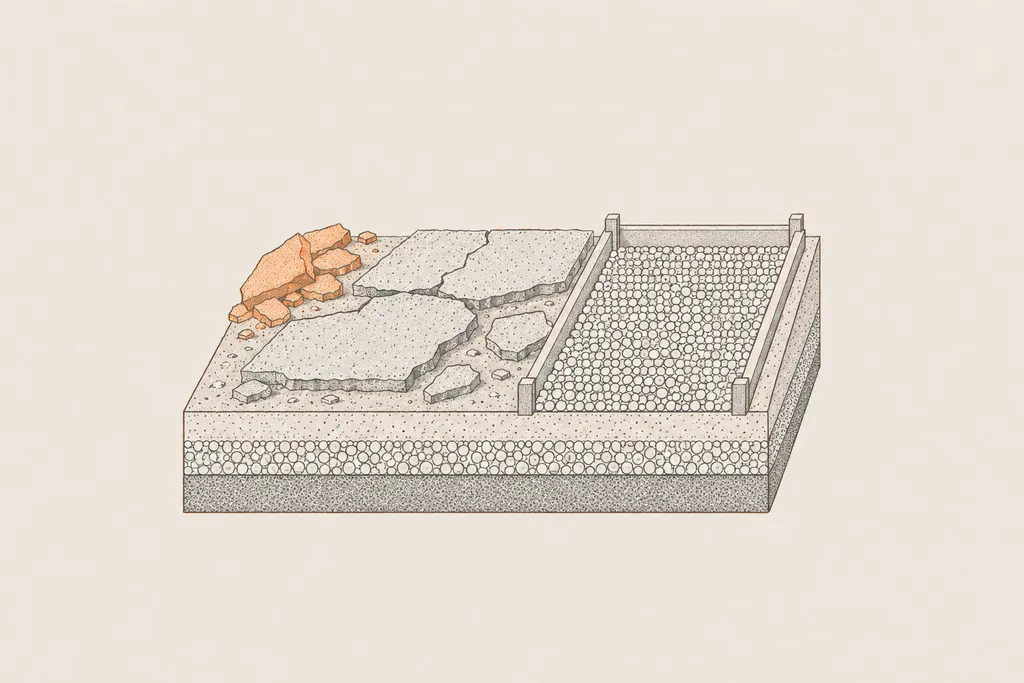
HomeAdvisor notes that “unless you are building a new home, contractors must remove the old driveway before pouring the new one.” What moves the removal price, per the guides:
- Steel in the slab. HomeGuide says removing reinforced concrete costs “$1 to $3 per square foot more due to cutting and disposing of rebar.” Fixr lists unreinforced removal at $2–$4 and reinforced at $4–$6 per square foot.
- Thickness. HomeGuide: slabs thicker than 4 inches “require more heavy-lifting equipment and take longer to remove.”
- Disposal. Fixr says about $0.50 to $2 of its $2–$6 per square foot is disposal. HomeGuide lists hauling at $30 to $65 per pickup truck load (up to 6 cubic yards of debris) and dump fees of $90 to $160 per ton.
- What’s underneath. Fixr says that with a replacement, “usually, only minor grading or changes to the sub-base are required.” Concrete Network adds that you might reuse some of the base material “if it’s in good condition.” Ask the contractor to say in writing whether the base stays, gets regraded, or gets replaced.
- Permit. HomeGuide says you need a removal permit “if it’s in the public right of way,” at $50 to $400. Fixr notes that when new concrete is being poured, “this permit usually covers the demo as well.”
HomeGuide says contractors typically break concrete up “with a jackhammer or excavator depending on the size and thickness” and haul it to a dump or recycling center. That’s work for the crew, so this page doesn’t give do-it-yourself steps; ask for removal as its own priced line in the bid.
What the new driveway should spell out
From Concrete Network’s construction checklist (updated March 2026), with HomeGuide’s rebar price:
- Thickness: “place concrete at a minimum thickness of 4 inches”; local soil and weather “may also require a thicker driveway slab.” Details: how thick should a concrete driveway be.
- Reinforcement: wire mesh for 4- to 5-inch driveways, rebar for 5 inches or more. HomeGuide prices rebar at $1 to $3 per square foot.
- Joints: control joints at most 10 feet apart in a 4-inch slab, cut to one-fourth of the slab depth, and an isolation joint where the driveway meets a sidewalk or garage floor. Concrete Network: “Ask your contractor to provide a jointing plan as part of his written proposal.”
- Drainage: a slope toward the street of at least 1/8 inch per foot, which Concrete Network attributes to the Portland Cement Association.
- Driving on it: “Let your concrete cure for at least a week before driving on it.”
The section at the street needs its own check. In Wentzville, Missouri, for example, “a permit is required for driveway additions and replacements when the proposed driveway is touching both the City street curb and the house foundation,” and the approach and sidewalk section must be 6 inches thick. Your city’s rule may be different, so ask your local building department before work starts. Call 811 a few business days before any digging so buried lines get marked.
When replacement makes sense
HomeGuide says that if a driveway “has extensive cracking, significant settling, or drainage issues, replacement is often more cost-effective in the long run,” and that a quality concrete driveway “should last 30 to 40 years with proper maintenance.”
Questions to ask before you sign
- Is tear-out and haul-away its own line, and does it include dump fees?
- Is my old slab reinforced, and does the price change if you find rebar or extra thickness?
- Will you reuse, regrade or replace the base, and how many inches of compacted base go under the new slab?
- What thickness, concrete strength (psi), reinforcement and joint spacing are in the contract?
- Does the job touch the curb, apron or sidewalk, and who pulls the permit?
- How long before I can drive and park on it?
To price your own driveway, with removal as a separate line, use the concrete cost calculator.
Have your own measurements? Run the concrete cost calculator — cubic yards, bags and a sourced price range for your size.
Illustrations here are AI-made sketches that show the idea. They are not photos of a real slab, driveway, product, job or person.
Sources
- HomeGuide — How Much Does a Concrete Driveway Cost? (June 3, 2025)
- HomeGuide — How Much Does Concrete Removal Cost? (May 27, 2025)
- Fixr — How much does it cost to pour a concrete driveway? (updated Jan 31, 2025)
- Fixr — How much does it cost to remove concrete? (updated Jan 31, 2025)
- HomeAdvisor — How Much Does a Concrete Driveway Cost in 2026? (updated Jun 20, 2026)
- This Old House — Driveway Repair and Replacement: Options & Costs (updated Mar 31, 2026; cost data via Angi)
- This Old House — Driveway Repaving Cost (updated Jun 5, 2026; cost data via Homewyse)
- Concrete Network — What's the Average Cost of a Concrete Driveway? (updated Jan 13, 2026)
- Concrete Network — 8 Concrete Driveway Construction Essentials (updated Mar 12, 2026)
- Concrete Network — How Much Concrete Do You Need for a Driveway? (no update date shown; checked Nov 2, 2026)
- City of Wentzville, Missouri — Residential Driveway Guide (revised May 3, 2024)
- Call 811 (Common Ground Alliance) — 811 Before You Dig (checked Nov 2, 2026)
Updated November 2, 2026
Before you build
Call 811 a few business days before any digging so buried utility lines get marked. Driveway aprons, foundations and taller retaining walls may need a permit — ask your local building department. Wet concrete can burn skin: crews wear gloves, boots and eye protection. Get the price, thickness, base and reinforcement in a written contract with a contractor who carries the license (where your state requires one) and insurance.